Choosing the right fiber optic cable can greatly impact your network performance. As George Smith, a renowned telecommunications expert, states, "Selecting the optimal fiber optic solution leads to better connectivity and reliability." Understanding how to choose the right fiber optic cable is essential for both personal and professional setups.
The process begins with understanding your specific needs. Consider factors like distance, bandwidth, and environment. Different fiber types serve different purposes. Single-mode fibers excel over long distances, while multimode fibers are best for shorter runs. You also need to think about installation requirements. Some cables are more flexible and easier to manage than others.
Moreover, be mindful of compatibility with existing infrastructure. Not all cables work seamlessly with every device or system. This consideration is often overlooked, leading to potential issues down the line. Therefore, reflecting on these details can enhance your decision-making process. In the complex world of fiber optics, a well-informed choice is key to building a robust network.
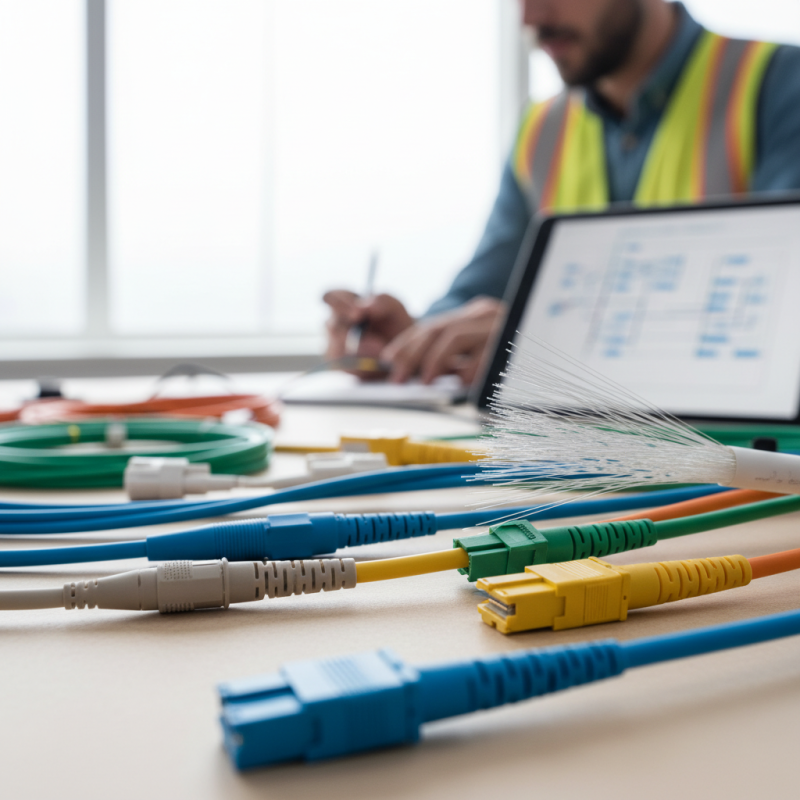
When choosing fiber optic cables in China, it's essential to understand the various types available. Single-mode and multi-mode fibers are the two primary categories. Single-mode fiber features a small core diameter, enabling it to transmit signals over long distances with minimal loss. This type is ideal for telecom networks and large installations. In contrast, multi-mode fiber has a larger core, allowing multiple light paths. It's well-suited for shorter distances, often used within buildings or for local area networks.
In addition to core types, there's also fiber cable construction to consider. There are armored cables that offer extra protection against physical damage. Outdoor cables often come with moisture-resistant jackets, making them suitable for external installations. Pay attention to the cable's lossy specifications, as this can affect performance. It's important to reflect on your specific needs, as the right choice depends on various factors. Network demands, installation conditions, and future scalability should guide your decision.
| Tip Number | Tip Description | Cable Type | Typical Use |
|---|---|---|---|
| 1 | Determine the purpose of the fiber optic cable. | Single-mode | Long distance communication |
| 2 | Consider the installation environment. | Indoor | Office and home use |
| 3 | Check the cable's bend radius. | Armored | Rugged environments |
| 4 | Verify the transmission speed requirements. | Multi-mode | Data centers |
| 5 | Assess the length of the cable run. | Plenum rated | Air handling spaces |
| 6 | Consider future scalability. | Loose tube | Telecom infrastructure |
| 7 | Evaluate the budget and cost effectiveness. | Outdoor | Street networks |
| 8 | Look for certifications and standards. | Fiber optic patch cord | Connecting devices |
| 9 | Ensure compatibility with existing equipment. | MPO/MTP | High-density applications |
| 10 | Get advice from industry experts. | Custom-built cables | Specific project needs |
: The two primary types are single-mode and multi-mode fibers. Single-mode is for long distances, while multi-mode suits shorter distances.
A larger core can transmit more signals but may cause more modal dispersion. Smaller cores excel in long-distance communication.
Indoor cables are lighter and more flexible. Outdoor cables need durability against moisture and temperature changes.
Bandwidth determines data transmission speed. Higher bandwidth enables faster connections for modern applications.
Attenuation is signal loss over distance. Lower values indicate better performance, especially for long runs.
Confirm that the chosen cable meets necessary standards for connectivity with your existing network equipment.
Armored cables offer extra protection. Moisture-resistant jackets are essential for outdoor installations. Reflect on your specific needs.
If requirements evolve, reassess your cable choice. Mismatched specifications can lead to underwhelming results.
Thorough research can prevent costly errors. Understanding specifications is critical for optimal performance.
Temperature and physical stress can affect performance over time. Higher temperatures may increase degradation risks.
When considering how to choose the right fiber optic cable, it's essential to understand the various types available in China, including single-mode and multi-mode cables, each suited for different applications. Key factors include your specific network requirements, distance, and data transmission speed. Performance specifications such as bandwidth and attenuation play a crucial role in ensuring reliable connectivity.
Additionally, evaluating installation and maintenance needs is vital to ensure that the chosen cables can be effectively integrated and managed within your existing infrastructure. Lastly, comparing costs and establishing a budget will help streamline the decision-making process, ensuring you select a high-quality fiber optic cable that meets your operational demands without exceeding financial constraints.

 XT Cabled