To understand what is fiber optic cable used for, picture a glass thread thinner than a human hair. It carries data as pulses of light, not electrical current. This design supports high capacity, long-distance transmission, and strong resistance to electromagnetic interference. It links data centers, mobile networks, offices, hospitals, homes, and undersea communication routes.
The demand is measurable. The International Telecommunication Union reported 5.4 billion people online in 2023, representing about 67% of the global population. Each video call, cloud backup, and online transaction adds pressure to network infrastructure. The OECD Broadband Statistics also showed that fiber accounted for more than 40% of fixed broadband connections across member countries in 2023. That shift reflects practical experience: copper networks often struggle with distance, congestion, and upgrade limits.
Undersea systems matter too. Industry research from TeleGeography consistently identifies submarine cables as carrying nearly all intercontinental Internet traffic. Nobel laureate Charles K. Kao, whose research helped make modern fiber communications possible, described the principle clearly: “Light can carry information over great distances.” His statement still feels accurate, although it simplifies today’s complex systems. Fiber cables need transmitters, receivers, switches, power, and careful maintenance. The cable alone cannot solve every connectivity problem.
This article examines how fiber optic cables transmit information, why network operators prefer them, and where their limitations appear. The technology is fast, but not magical. Its real value comes from the complete network built around it.
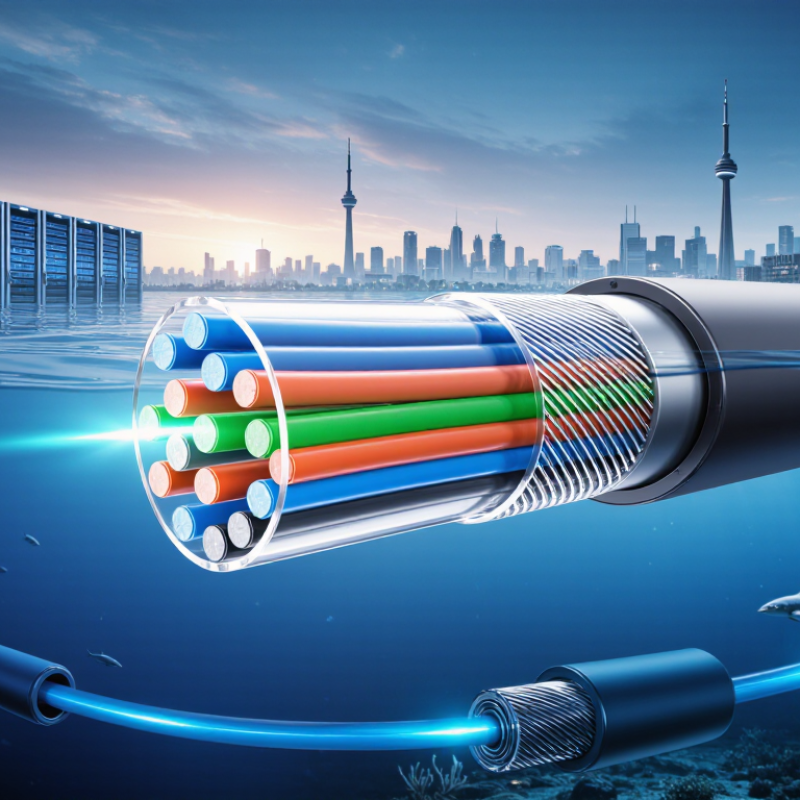
Fiber optic cable carries data as light, not electrical current. Its center contains a very thin glass core, surrounded by cladding with different optical properties. A protective jacket covers these delicate layers.
A transmitter converts digital data into rapid light pulses. A light source, such as an LED or laser, sends those pulses through the core. The cladding keeps light inside by reflection. At the other end, a photodiode detects each pulse and changes it back into electrical signals. The process happens billions of times across busy networks.
The cable is thin, but its capacity is impressive. Multiple light wavelengths can travel through one strand, increasing data throughput without adding more cables. Fiber also resists electromagnetic interference from motors, power lines, and industrial equipment. That makes it useful in data centers, communication networks, and long-distance links. Copper may suffer signal loss over distance, while fiber can maintain stronger performance across many kilometers.
Fiber is not invincible. It can break under sharp bends, crushing pressure, or careless handling. During installation, technicians often check bend radius and inspect connectors under magnification. A small speck of dust can weaken the signal. The explanation also sounds cleaner than real work; connectors age, measurements vary, and troubleshooting sometimes takes longer than expected. Light travels fast, but installation still demands patience.
A digital message begins as electrical bits inside a transmitter. The transmitter converts those bits into carefully timed light changes. In a simple illustration, a flash may represent one state and its absence another. Real systems use more sophisticated signaling, but the principle is similar. Light travels through the fiber’s narrow glass core, guided by the surrounding cladding. The boundary helps keep much of the light inside, even as the cable bends gently. Not magic—not magic? Just controlled light and precise timing.
At the other end, a photodetector senses the arriving light and turns it back into an electrical signal. Electronics measure the signal pattern, recover timing, and reconstruct the data. A clean path matters. Dirt on a connector, a sharp bend, or a long span can weaken or distort the signal. Engineers account for these effects with suitable cable, connectors, and equipment. This is a simplified picture; actual systems may encode information in several properties of light, not only flashes. That detail is easy to overlook.
Tips: Keep fiber connectors capped when they are not in use, and avoid tight bends. If a link performs poorly, inspect the connection and cable route before assuming the fiber itself has failed.
Fiber optic cable carries data as pulses of light through a thin glass core. Surrounding cladding keeps much of the light inside, even when the cable bends gently along a route. At the receiving end, a transceiver converts the pulses into electrical signals that computers can read. Light does not pick up electromagnetic interference from motors or nearby power cables. That helps preserve a clean signal in factories, hospitals, and crowded network rooms. Distance matters. As light travels, signal strength can fall, and pulses may spread enough to blur together. Suitable cable types, clean connectors, and careful installation help limit these losses.
These physical qualities make high data rates possible. A fiber strand can carry signals on different wavelengths, much like separate colors sharing one glass path. This expands capacity without requiring a separate cable for every stream. Fiber also has low signal loss compared with copper over long distances, so fewer repeaters may be needed. Still, cable alone does not set the actual speed. Transceivers, network equipment, distance, and traffic all matter. A fast link can feel slow. It is easy to overlook a tiny dirty connector, even when the cable beneath the floor supports impressive capacity.
| Data Dimension | Fiber Optic Cable | Copper Cable | Why It Matters for Data Transmission |
|---|---|---|---|
| How data is carried | Light pulses travel through glass or plastic optical fiber. | Electrical signals travel through metallic conductors. | Fiber carries information as light and is not affected by electromagnetic interference in the way electrical signaling can be. |
| Available link speeds | Fiber-based Ethernet systems support 10 Gb/s, 40 Gb/s, 100 Gb/s, and higher rates, depending on the fiber, optics, and network standard. | Twisted-pair Ethernet supports rates such as 1 Gb/s and, over specified cabling and distances, up to 10 Gb/s. | Fiber can provide high capacity for backbone links, data centers, and other networks that need to carry large volumes of traffic. |
| Typical Ethernet reach | Single-mode links can span many kilometers with compatible optical equipment. Multimode reach varies by fiber type and data rate and is generally shorter. | Common twisted-pair Ethernet links are limited to 100 meters per channel under the relevant cabling standards. | Longer reach can reduce the number of intermediate network devices needed between sites or buildings. |
| Signal loss over distance | Optical signal loss is low; single-mode fiber commonly has attenuation around 0.2–0.4 dB per kilometer near 1310–1550 nm, depending on the fiber and wavelength. | Electrical signal loss increases with cable length and signal frequency; performance depends on the cable category and installation. | Lower loss helps optical links carry signals over longer distances before amplification or regeneration is required. |
| Resistance to electromagnetic interference | Immune to electromagnetic interference because the signal is carried as light in a dielectric medium. | Can be affected by electromagnetic noise, depending on cable construction, shielding, and the installation environment. | Fiber is useful near industrial equipment, power systems, and other sources of electrical noise. |
| Electrical isolation | Does not conduct electricity between connected endpoints. | Conductive cable can create an electrical path between equipment, depending on the installation. | Fiber can help isolate network equipment across buildings or areas with different grounding conditions. |
| Data privacy considerations | Does not radiate electrical signals like a conductor, but the cable is not inherently secure and can still be accessed or tapped. | May emit detectable electromagnetic signals, depending on the cable and conditions; it can also be accessed physically. | Fiber can reduce some signal-leakage risks, but encryption and physical security are still important. |
| Power delivery | Standard optical fiber does not deliver electrical power to network devices. | Some Ethernet cabling can carry both data and power using Power over Ethernet, when supported by the equipment and cabling. | Copper may be more convenient for endpoints that need a single cable for data and power; fiber endpoints usually need a separate power source. |
Performance depends on the fiber type, cable quality, link length, optical transceivers, network standard, and installation. Figures are general reference values, not guarantees for every link.
Fiber carries data as light through glass, rather than as electrical signals through metal. The difference matters in a server room, where power cables and motors can create electromagnetic interference. Fiber is immune to that interference. No signal shielding needed. It also avoids ground-loop issues between electrically separated buildings. For long links, lower signal loss can reduce the need for repeaters. ITU-T Recommendation G.652 specifies maximum attenuation of 0.4 dB/km at 1,310 nm and 0.3 dB/km at 1,550 nm for relevant fiber categories.
Distance is a clear advantage. IEEE 802.3 defines many copper twisted-pair Ethernet links for channels up to 100 metres; fiber standards support links ranging from hundreds of metres to many kilometres, depending on the fiber and equipment. That can simplify connections between buildings or across a large facility. Fiber also supports wavelength-division multiplexing, which carries multiple optical channels on one strand. ITU-T Recommendation G.694.1 defines a frequency grid for dense wavelength-division multiplexing. More capacity, without laying a separate cable for every channel.
Still, fiber is not magic. Glass strands need careful handling, clean connectors, and suitable tools for testing and splicing. A dusty connector can cause real trouble. Copper may be simpler and cheaper for short office runs, especially when existing cabling works. The right choice depends on distance, interference, bandwidth needs, and installation conditions—not just headline speed.
Why Is Fiber Optic Cable Used for Data Transmission?
Fiber optic networks carry data as light through glass strands. This design supports high capacity, low latency, and resistance to electromagnetic interference. A cable can run beside motors, power lines, or radio equipment without collecting much electrical noise.
The applications are broad. Fiber forms the backbone of internet service, links data centers, and connects mobile network sites. It also supports cloud services, hospital imaging, financial systems, and industrial sensors. The OECD Broadband Statistics Update, based on December 2023 data, reported that fiber represented about 42% of fixed broadband subscriptions across OECD countries. Demand continues to grow. The International Telecommunication Union reported 5.4 billion people were online in 2023, increasing pressure on network capacity.
Fiber is not a perfect solution. Installing it across rural land can require expensive trenching, permits, and specialist labor. A sharp bend may increase signal loss. Dust on a connector can also disrupt transmission. Unlike copper, fiber does not carry electrical power, so remote equipment needs separate power systems. Repairs may take longer when a cable is buried under roads or water.
Field technicians often discover another limitation: the cable looks thin, but its installation is unforgiving. Small handling mistakes matter. Fiber remains highly effective, yet network planners should compare distance, budget, maintenance skills, and power requirements before choosing it.
Common Applications and Limitations of Fiber Optic Networks
Fiber optic cable is widely used because it provides high bandwidth, low signal loss, long transmission distances, and strong resistance to electromagnetic interference. The chart shows representative attenuation values for common optical operating windows. Lower attenuation allows signals to travel farther before amplification or regeneration is required.
It converts digital data into light pulses. These travel through a glass core, then a detector changes them back into electrical signals.
The core carries light. The surrounding cladding helps keep it inside through reflection.
Multiple wavelengths can share one strand, carrying separate data streams without extra cables.
Yes. Motors and nearby power cables do not disrupt its light signals in the way they can affect electrical signals.
Depending on the cable and equipment, links can span hundreds of metres or many kilometres. Signal loss still matters.
No. Transceivers, network equipment, distance, and traffic also affect performance. A fast link can still feel slow.
Dust on a connector, sharp bends, or crushing pressure can reduce signal quality. Tiny details matter.
Not always. Copper can be simpler and cheaper for short office runs, while fiber suits longer links or areas with interference.
Technicians check bend radius, inspect connectors, and test the link. Real troubleshooting can take longer than expected.
Fiber optic cable is a communication medium that uses thin strands of glass or plastic to carry data as pulses of light. To understand what is fiber optic cable used for, it helps to see how digital information is converted into rapid light signals. These signals travel through the fiber core and are guided by internal reflection, allowing large amounts of data to move quickly over short or long distances with minimal signal loss.
Fiber optic networks provide higher bandwidth, faster transmission, and better resistance to electromagnetic interference than copper-based cables. They are widely used for internet services, telecommunications, data centers, enterprise networks, medical systems, and connections between buildings or cities. However, fiber can be more delicate, harder to install or repair, and sometimes more expensive to deploy than copper. Despite these limitations, its speed, reliability, security, and ability to support growing data demands make it an essential choice for modern communication infrastructure.

XT Cabled